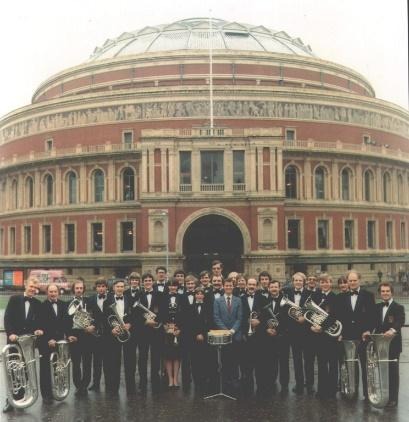
An Investigation of Archive Records by Mike Thorn (first published in 2016). Celebrating the 150th Anniversary of the Formation of the Hitchin Brass Band 1866 – 2016
I have been told many times over the years that the Hitchin Band was formed sometime in the 1860’s and that this makes it one of the oldest brass bands in the world still playing today. However, trying to establish this as a fact seemed almost impossible with very little available information readily to hand to confirm it. But after some extensive research, the result has become clear and we now have a record of the origins of the Hitchin Brass Band.
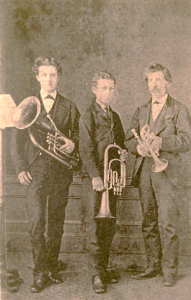
Founder members of the Hitchin Brass Band photographed c1872 Alfred Bailey, William Havelock Bailey, George Byron Bailey (Secretary)
There is a fairly extensive and readily available archive of contest results which seemed a good starting point. The earliest known contest record for Hitchin Band is from a competition in Stratford in 1897, although the record actually states that having entered the competition that year they actually withdrew before playing! The first recorded contest performance was on 24th July 1902 where Hitchin Band were awarded first prize in the Ashwell Contest, playing a piece called The Slave by Henry Rowley Bishop. But this is still some forty years after the band was supposedly formed.
I was certain there would be a way to establish when the band was formed and hoped that a search of old newspaper records would help. I set about searching through online archives of newspapers and began to gather information to help paint a picture. The records are often brief, but their frequency and regularity helps to add confidence to the story. The same can also be said, however, for times when the records are sparse, suggesting periods when the band may have struggled.
The earliest newspaper record that I have found of a Hitchin Band dates back to 30th September 1843, where a lengthy article in the Hertford Mercury and Reformer tells us about the sixth annual meeting of the Herts Agricultural Society. From early morning, the town was filled with visitors from all neighbouring towns, with many visitors from distant districts. The local population of Hitchin naturally took great interest in the event, with almost all businesses in the town closing for the day, except of course for the numerous inns that would fare so well from the influx of trade from the visitors. The Sun Inn had expected between 150 and 200 dinner guests but in the end had to cater for over 300. Entertainment was provided by glee singers as well as the Hitchin Band who were stationed in the immediate vicinity of the pavilion, and performed various airs during the evening.
The next report of a Hitchin Band comes from the 15th June 1844 edition of the Hertford Mercury and Reformer, reporting on the first anniversary of the Hitchin (Albert) Lodge of Odd Fellows. The society celebrated their anniversary with a large dinner party at the Crown Inn which was beautifully decorated for the occasion. According to the account, the festivities were ushered in by a merry peal from the church bells, and the Hitchin Band, led by Mr. Woodward, enlivened the town with some spirited pieces.
Unfortunately we do not know the format of this band, whether brass, reed, or some other mix of instrumentation. Could this have been a brass band? I think this is doubtful. Whilst woodwind instruments had been in use for a considerable time, valved brass instruments had not. The Belgian instrument designer Adolphe Sax had developed a family of saxhorn instruments in the 1830s, patenting the designs in Paris in 1845. These saxhorns with piston valves are the basis of instruments still used in brass bands today. Whilst it is possible that the instrumentation of the Hitchin Band of the early 1840s could have been solely or partly brass, it is more likely to have been a wind band or a drum and fife band.
In any event there follows a long period without mention of a Hitchin Band in the newspapers until we reach the 1860’s. By this time music seems to have become an important part of public celebrations and it is possible to imagine the start of some rivalry between local societies and social movements trying to put on the best show in the town to get one up on each other.
In 1861 the Hertford Mercury and Reformer once again picks up the story with a report on the 24th annual festival of the Temperance Society in Luton. A fine summer’s day saw a large turnout at a local meadow where a 90’ by 35’ tent had been erected for members and their wives to take tea. There were various amusements and entertainments laid on, including the engagement of the Hitchin Band of Hope Drum and Fife Band. This event and indeed the formation of a drum and fife band associated with the Band of Hope and the Temperance Society reflect the growth in a social movement towards teetotalism.
The Temperance movement originates from the 1830s and encourages abstinence from alcohol. After a pledge in 1832 by a Joseph Livesey and fellow workingmen from Preston that they would never again consume alcohol, they gained sufficient support that by 1835 the British Association for the Promotion of Temperance was formed. Initially abstaining from drinking spirits, by the 1840s they were lobbying for complete teetotalism. The Band of Hope founded in Leeds in 1847 was a temperance society supporting working class children and helped to increase the number of teetotallers.
Moving on to Whit-Wednesday 27th May 1863, the Hertford Mercury and Reformer records a number of events taking place in Hitchin that day and includes the first reference to a Hitchin Brass Band.
Members of the Benefit Society had their annual dinner, after which they paraded the streets headed by the Hitchin Brass Band. Benefit Societies were established for members to create and pay into a fund which could be used by members or their families in case of sickness or other difficulties.
On the same day, the Temperance Drum and Fife Band led a parade for the Foresters Lodge around the streets of Hitchin, finishing at a teetotallers demonstration. The Lodge of about 30 members had recently been formed at the “Trooper” and gained several new applications for membership following the parade. Like the Benefit Society, the Foresters Lodge would have been a ‘Friendly’ or ’Mutual’ society where members paid into a fund to safeguard against future difficulties.
Later that same day, the Band of Hope Drum and Fife Band are reported to have played in support of the temperance cause. With the near demise of the Whit-Wednesday Fair, it had become common for annual demonstrations of the temperance movement to take place on that day. 1863 saw a much larger attendance than usual. At half past four, tea was served for members in a spacious tent before being opened to the public at six o’clock. Following addresses by various advocates of the cause, the large audience was entertained in the evening with music provided by The Band of Hope drum and fife band.
The newspaper report of the events of that day allows an insight into the social movements of the time, but does not help us identify the origins of Hitchin Band. There is a clear reference to a brass band, but is this an established group or a few individuals who have been encouraged to come together for one event? There is no further mention of a brass band until 1866, some three years later.
With a growing temperance movement and the appearance of temperance bands, there does of course still remain the possibility that not all of the local musicians supported the notion of abstinence. There is today a popular stereotype image of a brass player with a pint of beer in hand. If it is possible that a number of musicians were not able to be teetotal, it is likely that they would need to find a non-temperance band to play with, if not start their own. It would be speculation to suggest that this is why there appear to be several bands performing in Hitchin on the same day and coincidental that the one band not associated with the temperance movement is a brass band. But it would make for an interesting start to the origins of Hitchin Band!
Moving forward to 1866, a number of important events started to unfold in and around Hitchin, all of which are likely to have played their part in the establishment of a brass band. Although probably coincidental, these factors came together as if they had been written as an overture.
These include the availability of a successful Bandmaster with the soon to be disbanded Bedfordshire Militia band; two closely connected families with talented musical children; the formation of a management committee; and the arrival in Hitchin of a Professor of Music.
The 18th Light Infantry Militia (Bedfordshire), based not far from Hitchin, had been commanding increasing respect for the conduct of its men. At an inspection parade in May 1866, the Beds Militia were commended for their field movements and presentation, with particular mention of their excellent band, under the direction of their Bandmaster, Sergeant Dean. This was the final parade before the Beds Militia was ‘disembodied’. By this time Sergeant Dean has already begun leading the Sharnbrook Brass Band, and reports later in the year suggest that he also becomes involved with training Hitchin Brass Band.
Later the same month, the Hertford Mercury and Reformer reports on the Whitsuntide Fair of Wednesday 23rd May 1866, where there was a large influx of visitors to Hitchin on the Tuesday, many more than in previous years. The Hitchin Benefit Society had their annual dinner on the day of the fair. They dined at the Bricklayers’ Arms before marching the streets in the afternoon, led by the drum and fife band. The same day, some 170 members of the Foresters Court gathered at the Swan Inn to celebrate their anniversary. They processed to St Saviours Church for a full choral service before returning to the Swan Inn for dinner. Later that evening they paraded the streets of Hitchin headed by “a brass band”. Unfortunately, the article offers no help in identifying the band, whether it was from Hitchin or elsewhere.
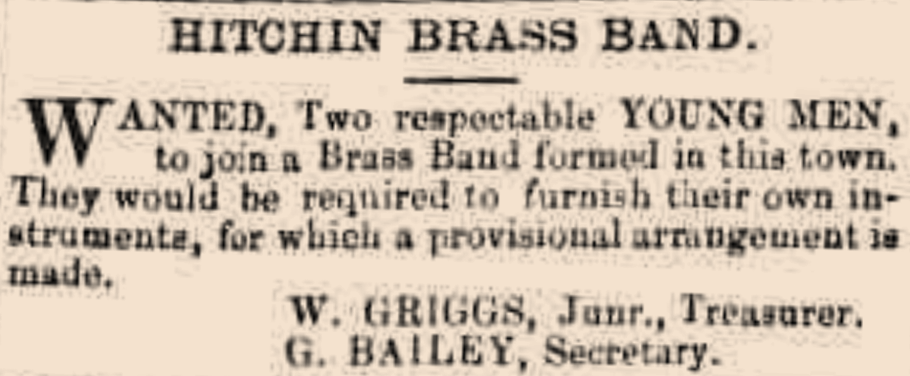
In July 1866 an advert appears in the Hertfordshire Express and General Advertiser:
HITCHIN BRASS BAND.
WANTED, Two respectable YOUNG MEN, to join a Brass Band formed in this town. They would be required to furnish their own instruments, for which a provisional arrangement is made.
W. GRIGGS, Junr., Treasurer.
G. BAILEY, Secretary.
This is our first real indication of the formal establishment of the Hitchin Brass Band, with a requirement for two men to build sufficient numbers and an organised committee to manage its affairs. But who are Griggs and Bailey?
William Griggs (Jr.) was born in 1844, the eldest son of William Griggs (Sr.), a baker who moved to Bancroft, Hitchin. George Byron Bailey was born in 1849, the son of a hat maker, Thomas Henry Bailey, who moved to Bucklesbury, Hitchin in 1846 where he set started a hat shop. George was one of ten siblings, of which it is believed four of five were musicians.
George Bailey’s younger sister Jemima married William Griggs’ younger brother Frederick and with the two houses becoming closely involved, it comes as no surprise to find a group that is willing to work together.
The Baileys continue to be involved with the band for a number of years. A photograph from the early 1870s (shown above) provided by a descendant of the Bailey family shows three brothers posing with their instruments, Alfred Bailey (euphonium), William Havelock Bailey (tenor horn) and George Byron Bailey (cornet).
Towards the end of 1866 we see a series of newspaper reports that give clear indications as to the size of the band, their preparations, date of first performance, the fact that there have been difficulties setting up a band in the past, and a hope that this band will become permanent.
Regarding the preparations to establish a Hitchin Brass Band, on 20th November 1866, the Herts Guardian, Agricultural Journal, and General Advertiser gives the following brief report in its Hitchin column,
BRASS BAND.— The members of this band are progressing favourably with their practices, and in a few weeks will make their debut.
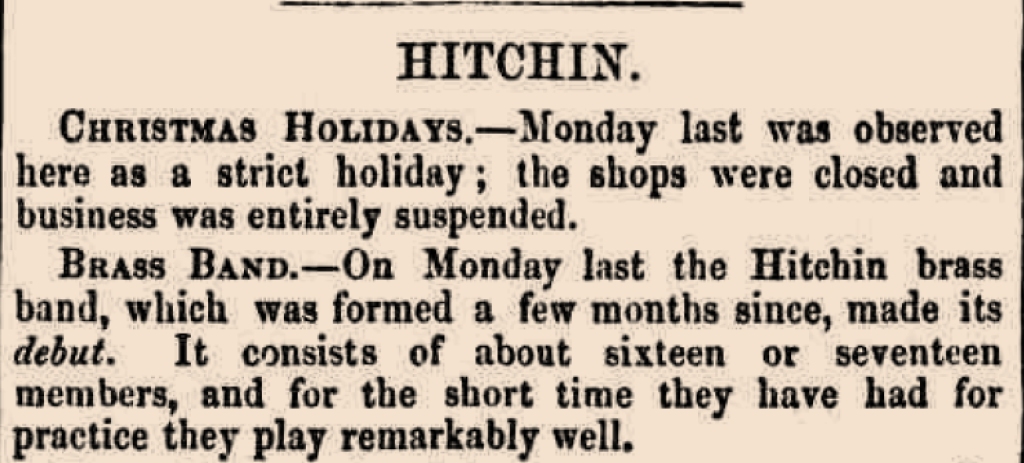
There are a number of reports regarding the debut performance of the band, which would have taken place on 24th December 1866. On 29th December 1866, in the Hitchin column of the Hertford Mercury and Reformer, we read,
And again on 29th December 1866, this time in the Herts Guardian, Agricultural Journal, and General Advertiser, under the Hitchin column we see,
BRASS BAND.— After several attempts, a brass band has been started in this town, and from the present appearances, it is likely to permanency. On Monday they made their debut performance after four months practice, under a very efficient teacher; and considering the difficulties to be got over in commencing a band they played extremely well.
A further report on the band’s performance, this time by the Hertfordshire Express and General Advertiser:
On Monday morning quite a musical treat was given in the Market Square by the Hitchin Brass Band. The members of the band assembled, to the number of fourteen, and played a miscellaneous selection of airs, in a style very much to their credit. This band has only been a short time in existence, and the perfection to which they have arrived, under the careful training of Bandmaster Dean, of the Beds. Militia, is something marvellous.
These reports maybe brief they but do provide lots of information. Preparations have been for only a short time but the band was able to play a range of music to a credible standard. Sergeant Dean is involved with training the band, not only musically but apparently also for deportment. And we know roughly the size of the band. “Likely to permanency” demonstrates a confidence in the future of the band, despite apparent difficulties in getting the band started previously.
I know the challenges of establishing a brass band in the twenty first century as I was the founding Chairman of Norfolk Wherry Brass, a band formed from scratch in 2003. It was not an easy job, even with modern telecommunications, social media, access to transport, an available pool of second hand instruments to purchase and local bands and musicians able to lend instruments, equipment and sheet music. I had experience on my side, having managed bands previously. I am pleased to report that with a number of willing and capable volunteers and musicians to get things off the ground, the Norfolk Wherry Brass quickly gained momentum to become a successful band and continues to prosper to this day.
Starting a band 150 years ago, with little resource or experience would have taken a great deal of effort, determination and leadership.
But from 1866 there was a confidence about the future of the Hitchin Brass Band, with reports of the time suggesting it was “likely to permanency”. This confidence was not misplaced and is evidenced by there being around thirty or more newspaper articles about the Hitchin Brass Band from 1866 through to 1880.
We have learned a little about some of the people involved in the band in these early years, the Griggs and Bailey families providing players and committee officers and Sergeant Dean training. G. Bailey is referenced as the band’s leader in 1870 and later in 1877 there is a further reference to a Mr Stracey as the band leader. There is an earlier reference to the Baileys and Straceys playing together in small ensembles in 1868, so it is likely that the Straceys may also have been involved from the beginning.
Of further interest is a reference to Herr Selmar Kahlenberg, a former student of Meyerbeer and the Leipzig Conservatoire, who moved to England and in settled in Hitchin. He is cited as Musical Director in 1868 and 1869 and continues to provide tuition for the band in 1870.
Census records of 1871 state Kahlenberg was Russian born but in later records he claims to be German. It is possible that he moved to England to escape the Austro-Prussian War of the summer of 1866.
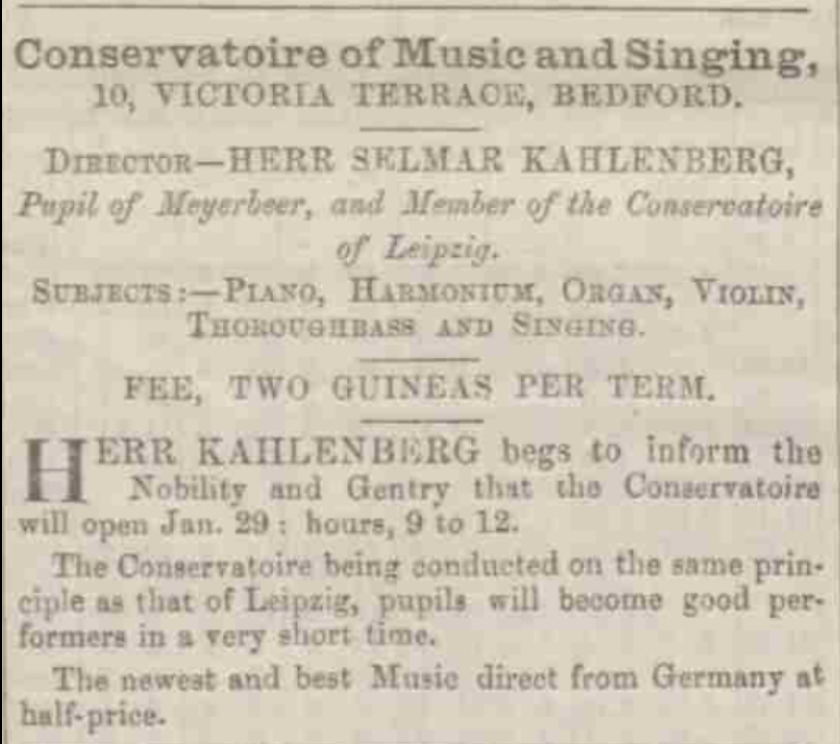
In June 1866 Kahlenberg married Frederica Dubi, of Tilehouse Street, Hitchin. Frederica was also either Russian or German born and a tutor of modern languages. In January 1867, Selmar opened a Conservatoire of Music and Singing in Victoria Terrace, Bedford, promising that for a fee of two guineas per term, “pupils will become good performers in a very short time”.
Madame Dubi Kahlenberg also offers private tuition at Victoria Terrace, in modern languages, painting and music for just one guinea per term. Their daughter Cassandra is born in Hitchin in 1867.
Kahlenberg undoubtedly becomes a prominent figure in the performing arts. An article in the Hertford Mercury and Reformer from February 1868 describes a packed house for Penny Readings at the Town Hall. It was so popular that hundreds more that arrived were unable to gain entry. The music for the evening was under the direction of Herr Selmar Kahlenberg, whose performances “afforded much pleasure”. Among the programme items the Brothers Kahlenberg perform one of Selmar’s own published works, “The Desert King”.
Kahlenberg is listed in the Alumni Cantabrigiensis, the record of past students of the University of Cambridge, for a musical degree from St John’s College in 1870.
By 1871 the Kahlenbergs had moved to Benslow Terrace, Hitchin and employed a governess. But then in 1876, Selmar Kahlenberg was appointed as a teacher of modern languages and music at the Brechin School, Scotland and there is no further trace of his association with Hitchin.
With the suggestion in 1866 that there had been some previous difficulties starting a band, one can imagine that the arrival of Kahlenberg in Hitchin did much to improve the situation. Whilst he may not have been directly involved in starting Hitchin Band, the presence of such a prominent teacher and advocate of music, together with the popularity of public performances, is likely to have encouraged potential amateur musicians. In an environment of increasing awareness of, and opportunities in, musical tuition and performance it is easy to see how this influence would generate increasing confidence amongst musicians in and around Hitchin.
I would suggest that with Kahlenberg’s musical inspiration, Sergeant Dean’s military training and the dedication of the Bailey and Griggs families, it is the combination of these factors that created the foundation for the start of the Hitchin Brass Band.
Having explored newspapers archives, public records, and personal family history accounts, there is an abundance of clear evidence to conclude that the Hitchin Brass Band was formed in 1866. Trying to link to earlier dates does not work. There are too many gaps in the records to connect to the Hitchin Band mentioned in the 1840s. There is no indication of what type of band this was and it is doubtful it would have been a full brass band due to the availability of instruments. Whilst there is mention of a brass band in the early 1860s, again it does not appear regularly and the reports of late 1866 indicate that there had been difficulty starting a band and keeping it going. The advert for players, reference to rehearsals and the debut performance in 1866 are clear and the abundance of ongoing records from that year onwards confirms that once established it became viable for many years to come.
Today’s Hitchin Band is still going strong and has become a vital part of Hitchin’s living heritage. Entertaining the people of Hitchin and surrounding areas; supporting local charities and community groups; training young musicians; working with experienced musical directors to strive towards quality musical performance; representing Hitchin in regional and national competitions; forming a cornerstone of music and the arts in North Hertfordshire; and giving the town of Hitchin a brass band to be proud of.
If the pioneers of Hitchin Band from 1866 were to know of the legacy they have created that is continuing 150 years on, I am sure they would be proud too.
Mike Thorn Secretary, Hitchin Band March 2016
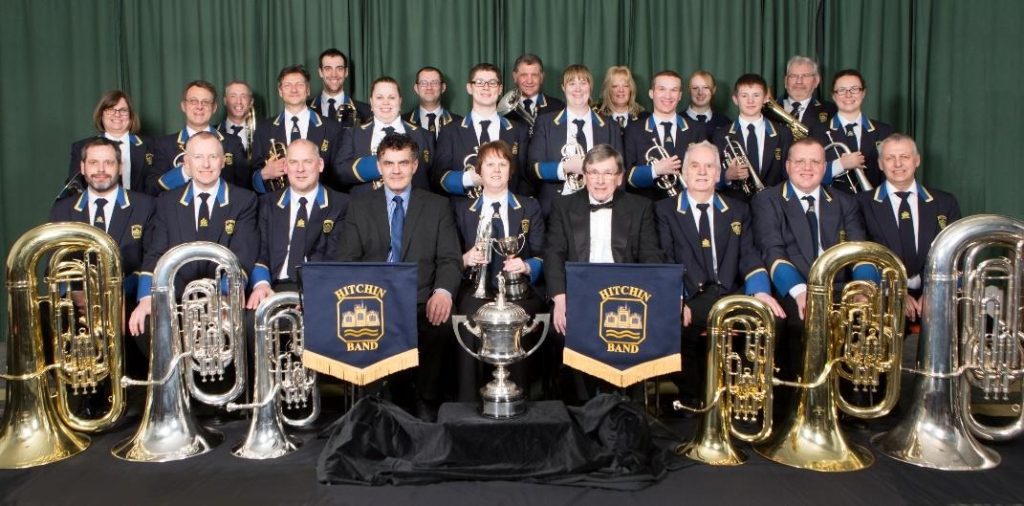
Hitchin Band, winners of the Peoples Challenge Trophy, March 2016 With Musical Director Graham Chambers, Principal Solo Cornet Dinah Birch and Band President Richard Whitmore